


Kaolin Clay Selection Guide for Ceramics, Paints, Paper & Other Industries
A practical guide for international buyers evaluating Kaolin Clay according to application, product form, particle size, brightness, moisture, processing and supplier documentation.
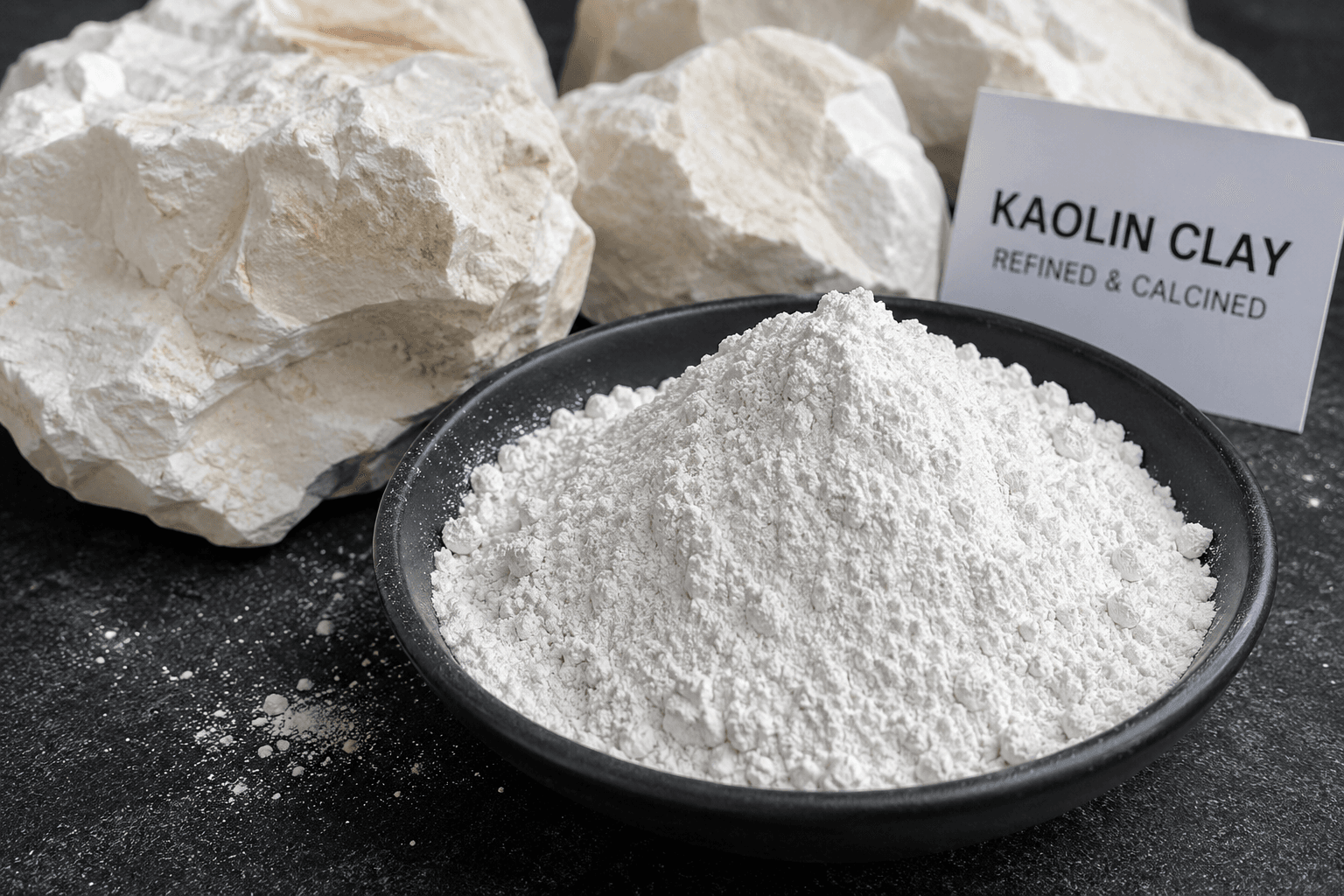
Choosing Kaolin Clay starts with the application, not simply the product name. Ceramic, paint, paper, rubber, plastic and other industrial users can require different combinations of brightness, particle size, moisture, purity, dispersion and product form.
1. Start With the End Application
Kaolin is used across a wide range of industries, but each application can place different demands on the material. A ceramic manufacturer may focus on whiteness, particle size and firing behaviour, while a paint or coating manufacturer may be more concerned with dispersion, brightness, opacity and consistency.
Ceramics
Buyers may evaluate brightness, particle size, moisture, purity and behaviour during body preparation and firing.
Paints & Coatings
Fine particle size, dispersion, brightness and consistency can be important depending on the formulation.
Paper
Buyers can evaluate brightness, particle characteristics and the material's suitability for coating or filling applications.
Rubber, Plastics & Other Industries
Product requirements can vary significantly with formulation, processing method and desired finished-product properties.
2. Hydrous vs Calcined Kaolin
One of the first questions in Kaolin procurement is whether the application requires hydrous Kaolin or calcined Kaolin. The processing route changes the material's physical and functional characteristics.
| Characteristic | Hydrous Kaolin | Calcined Kaolin |
|---|---|---|
| Processing | Naturally processed / refined without calcination | Heat-treated through a calcination process |
| Typical Buyer Focus | Brightness, particle size, dispersion and application fit | Application-specific performance after thermal treatment |
| Use | Ceramics, paper, paints and other industrial applications | Selected coatings, ceramics and specialty applications |
| Selection | Match against the buyer's formulation and specification | Confirm the required calcined grade and performance target |
3. Why Brightness Matters
Brightness is an important characteristic for applications where the colour, appearance or optical performance of the finished product matters. However, buyers should avoid comparing suppliers using brightness alone.
The test method, sample preparation and complete specification should also be considered when comparing different Kaolin sources.
4. Particle Size & Distribution
Particle size can influence dispersion, surface area, packing and processing behaviour. The required particle size depends on the final application and the buyer's production process.
Buyer Questions on Particle Size
- What is the target median particle size?
- Is a maximum particle size specified?
- Is a PSD report available?
- What percentage of the material falls within the target range?
- How consistent is the distribution from shipment to shipment?
5. Moisture & Physical Form
Moisture can affect storage, handling, weighing, packaging and processing. Buyers should therefore define an acceptable moisture range where it is important to their application.
The physical form should also be agreed. Depending on the grade and supplier, Kaolin may be offered as powder or in another processed form suitable for the application and handling system.
6. Chemical Composition & Purity
Kaolin selection should include review of the complete chemical composition, especially where the material is being used in a controlled industrial formulation.
| Parameter | Why Buyers Review It | Buyer Action |
|---|---|---|
| Al₂O₃ | Important part of Kaolin chemistry and useful for comparing material composition. | Compare with the approved technical specification. |
| SiO₂ | Shows the silica component present in the mineral composition. | Review together with the complete oxide analysis. |
| Fe₂O₃ | Can influence colour and is therefore relevant to appearance-sensitive applications. | Confirm the buyer's maximum permitted level. |
| Moisture | Affects handling, storage and process consistency. | Agree a suitable maximum level. |
| LOI | Can help indicate volatile or structural components in the material. | Compare against the applicable grade specification. |
7. How to Compare Kaolin Suppliers
Supplier Evaluation Checklist
- Application and grade are clearly defined
- Recent technical specification is available
- Relevant chemical analysis is available
- Brightness test method is identified where applicable
- Particle-size or PSD information is available
- Moisture and physical form are agreed
- Representative sample can be tested
- Packaging and export documentation are available
- Supplier can support the required commercial quantity
8. Why Sample Testing Comes Before Bulk Supply
Kaolin is an application-sensitive industrial mineral. A grade that appears suitable on paper may still behave differently in the buyer's formulation. A representative sample allows the buyer to confirm practical suitability.
A sensible sourcing sequence is:
- Requirement: Share application and technical specification.
- Grade: Confirm the appropriate Kaolin type and form.
- Sample: Test brightness, PSD, chemistry and application performance as required.
- Trial: Evaluate commercial material before recurring supply.
- Supply: Proceed after technical and commercial approval.
9. Buyer FAQs
How do I choose the right Kaolin grade?
What is the difference between hydrous and calcined Kaolin?
Should I compare Kaolin suppliers using brightness alone?
Can I request a Kaolin sample before a bulk order?
Can Kaolin specifications be customized?
10. Final Takeaway
The right Kaolin is the material that consistently matches the buyer's application, chemistry, brightness, particle size, moisture and processing requirements.
A clear specification followed by sample testing and commercial verification provides a stronger basis for long-term Kaolin sourcing than comparing price and product names alone.
Looking for Kaolin Clay for Your Application?
Share your application, required grade, technical specification and quantity. Our team can review the requirement and discuss a suitable Kaolin Clay option.