


How to Select Bentonite for Drilling, Foundry & Civil Engineering
A practical guide to evaluating Bentonite grade, swelling, moisture, particle size, gelling behaviour and supplier documentation for industrial applications.

The best Bentonite grade depends on what the material needs to do in the customer's process. Drilling, foundry and civil engineering applications can require very different combinations of swelling, binding, sealing, gelling, moisture and particle-size performance.
1. Start With the Application
Bentonite selection should begin with the intended application rather than the product name alone. A drilling-fluid buyer, foundry customer and civil engineering contractor may all ask for "Bentonite" while requiring very different performance characteristics.
Drilling
Focus on slurry behaviour, swelling, suspension, filtration and other drilling-fluid performance requirements.
Foundry
Focus on binding behaviour, mould performance, moisture and particle-size characteristics.
Civil Engineering
Focus on sealing, slurry stability, swelling and the ability to maintain required performance during the project.
Construction & Industrial Uses
Requirements vary by application and should be matched to the specific technical specification rather than a generic grade.
2. Swelling & Gelling Performance
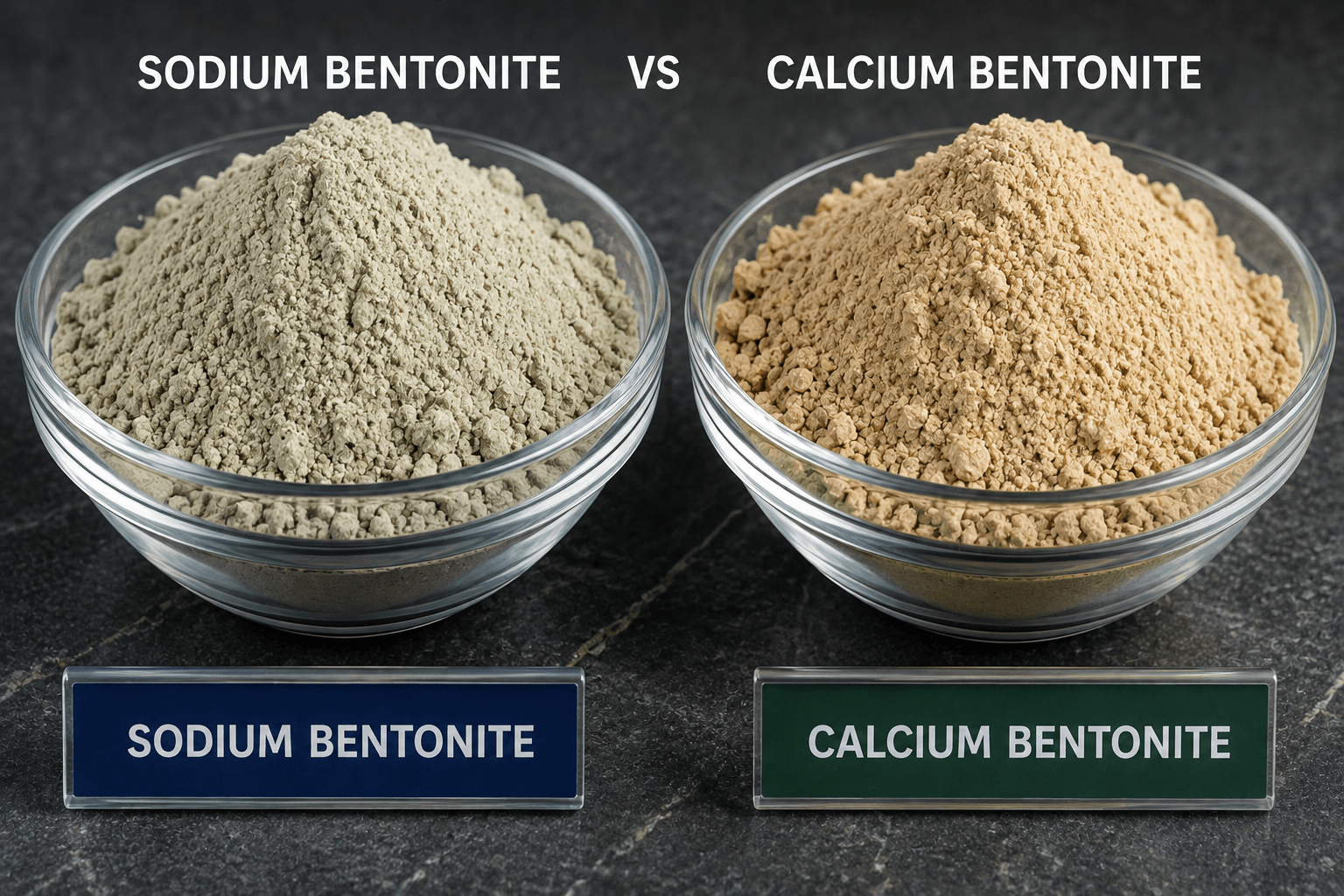
Swelling behaviour is one of the most important characteristics buyers consider when selecting Bentonite. Sodium Bentonite is commonly associated with stronger swelling and sealing performance, while other grades may be selected where absorption or different functional properties are required.
For a technical procurement decision, buyers should request the supplier's tested swelling value and understand the test method used.
3. Which Specifications Should Buyers Compare?
| Parameter | Why It Matters | What the Buyer Should Request |
|---|---|---|
| Montmorillonite Content | Helps describe the proportion of the principal swelling clay mineral. | Target value and test method. |
| Free Swelling Value | Provides an indication of swelling behaviour in water. | Test result with units and method. |
| Gelling / Viscosity | Important where slurry or suspension behaviour matters. | Relevant test value and applicable standard. |
| Moisture | Affects storage, handling, weighing and product consistency. | Maximum agreed moisture level. |
| Particle Size / Mesh | Affects handling, dispersion and process performance. | Mesh range or PSD requirement. |
| pH | Useful for evaluating material characteristics in some applications. | Typical or required pH range. |
4. Selecting Bentonite for Drilling
Drilling buyers should define the required performance before selecting the grade. Depending on the drilling application, important considerations can include swelling, viscosity, filtration control, suspension and stability under the intended operating conditions.
Drilling Buyer Checklist
- Intended drilling application identified
- Required Bentonite type confirmed
- Swelling requirement defined
- Viscosity / gelling requirement defined
- Moisture limit agreed
- Mesh / particle-size requirement agreed
- Applicable technical standard identified
- Sample tested before commercial approval
If the buyer has an existing drilling-fluid specification or approved laboratory standard, it should be shared with the supplier before the grade is quoted.
5. Selecting Bentonite for Foundry Applications
Foundry customers may evaluate Bentonite according to its binding, mould-strength and moisture-related behaviour. The correct grade depends on the moulding system, sand system and operating conditions.
Buyers should therefore avoid selecting a grade solely from the words "foundry Bentonite" and instead compare the technical data with their existing foundry formulation.
6. Selecting Bentonite for Civil Engineering
Civil engineering projects may use Bentonite where swelling and sealing are important. Requirements can vary between piling, diaphragm-wall, drilling and other construction-related applications.
The procurement specification should identify the required slurry behaviour, sealing performance, moisture, particle size and other project-specific parameters.
7. Powder, Granule & Mesh Considerations
Bentonite can be supplied in different processed forms depending on the application and handling requirements. Buyers should specify the desired form and particle size rather than assuming one physical form is suitable for every process.
UMA's current Bentonite product information identifies Sodium and Calcium grades, fine powder and controlled granule options, and applications in drilling, foundry and civil engineering. fileciteturn45file4L447-L455
8. How to Evaluate a Bentonite Supplier
Supplier Evaluation Checklist
- Recent technical specification available
- Laboratory or COA data available where applicable
- Sample available for testing
- Grade can be matched to the buyer's application
- Production quantity can support the required volume
- Packaging meets handling and transport requirements
- Export documentation can be provided
- Trial shipment can be considered before regular supply
9. Why Sample Testing Matters
A Bentonite supplier's specification is useful, but the buyer's own laboratory or process test remains an important part of technical approval. This is especially relevant when the material influences drilling-fluid, moulding or slurry performance.
A practical sequence is:
- Requirement: Share the application and technical specification.
- Grade: Confirm the appropriate Bentonite grade.
- Sample: Evaluate the sample in the buyer's laboratory or process.
- Trial shipment: Verify actual commercial material where appropriate.
- Regular supply: Proceed after technical and commercial approval.
10. Buyer FAQs
Which Bentonite should I use for drilling?
What Bentonite specifications should a foundry buyer check?
What should a civil engineering buyer specify?
Can I request a Bentonite sample before a bulk order?
Can the Bentonite grade or particle size be customized?
11. Final Takeaway
Selecting Bentonite should begin with the application and required performance, not simply the product name. Drilling, foundry and civil engineering buyers can require different combinations of swelling, binding, sealing, moisture and particle-size characteristics.
A clear technical specification, representative sample and practical verification process provide a stronger basis for long-term Bentonite sourcing.
Looking for Bentonite for Your Application?
Share your Bentonite application, required grade, technical specification and quantity. Our team can review your requirement and discuss a suitable supply option.